Six Motions, Split Three and Three
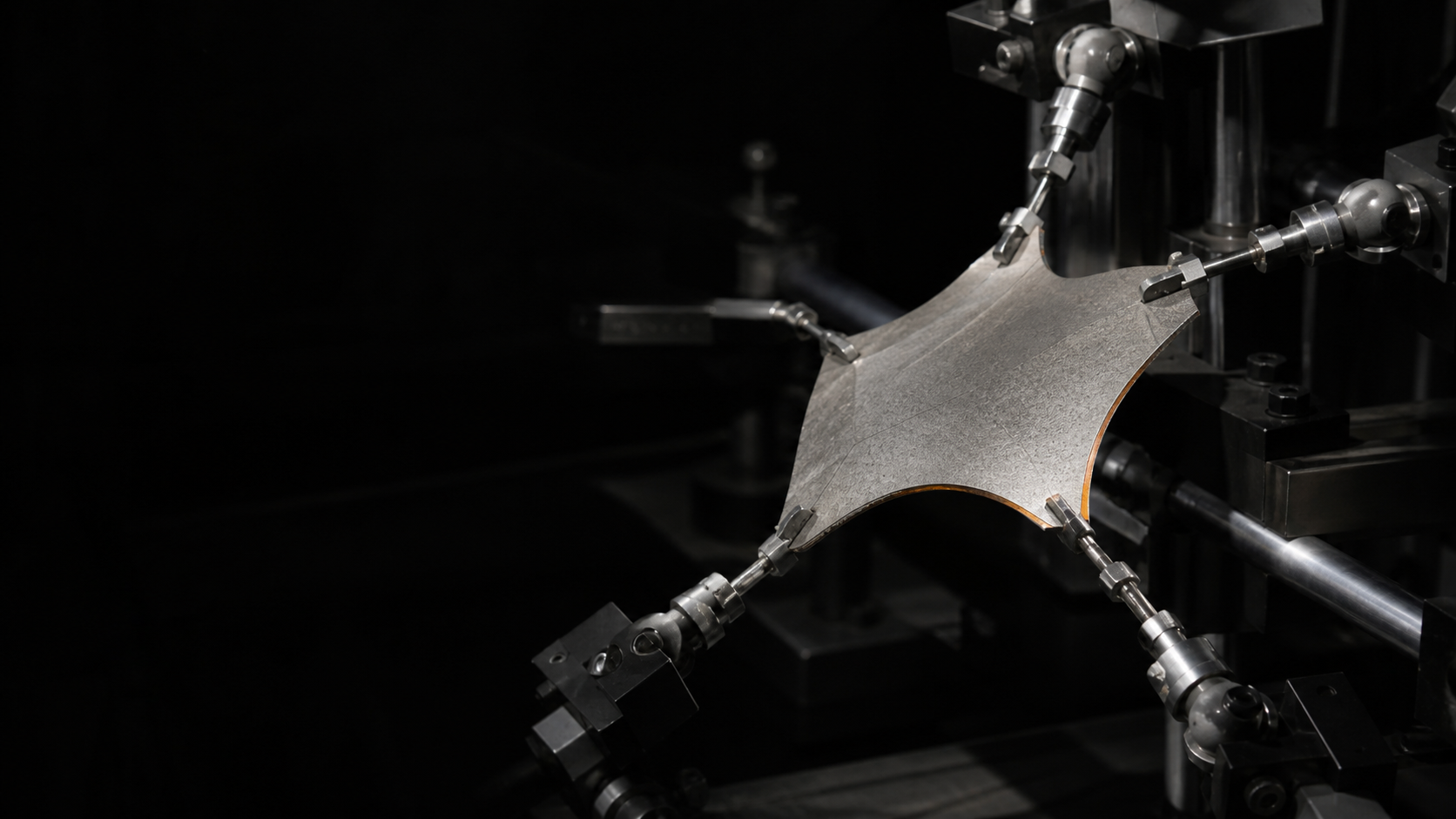
Pull a shell in two directions, shear it, bend it in two directions, and twist it. Those are its six broad macroscopic modes of deformation. Hussein Nassar’s paper proves that a simply connected shell always resists three and complies with the other three.
The count depends on topology. A simply connected shell has no holes and no handles. Its surface may be smooth, corrugated, folded, or densely wrinkled, and the three-to-three split remains.
Wrinkles Redistribute Stiffness
A fold can make a sheet much harder to bend in one direction. The counting rule says that gain appears with compliance somewhere else in the six-dimensional deformation space. Geometry can move stiffness among stretching, shearing, bending, and twisting. It cannot create a fourth resistant mode.
A flat sheet begins with three pure bending modes. Corrugation can trade one of those for a membrane mode. More elaborate patterns can produce other combinations while preserving the total count.
Force Balance and Shape Use the Same Mathematics
The proof connects two descriptions of a shell. One describes stresses that satisfy force balance. The other describes motions that preserve distances along the shell’s middle surface. At the local level, the equations take the same form. Averaging them across a repeating surface pattern produces the exact three-and-three balance at full scale.
The Rule Becomes a Design Constraint
A soft robot may need a skin that twists while carrying tension. A deployable structure may need to fold along one path and lock against another load. The new rule gives both designs the same starting question: which three motions should remain easy?
Holes and handles change the count. For the wide class of simply connected shells, every ridge and wrinkle works within the same fixed stiffness budget.