A Delayed Reward Must Find the Right Neural Event
A zebra finch builds song from precisely timed activity across thousands of neurons. Feedback arrives later and carries a broad message about whether the sound worked. The brain still has to identify the cell and moment that deserve credit.
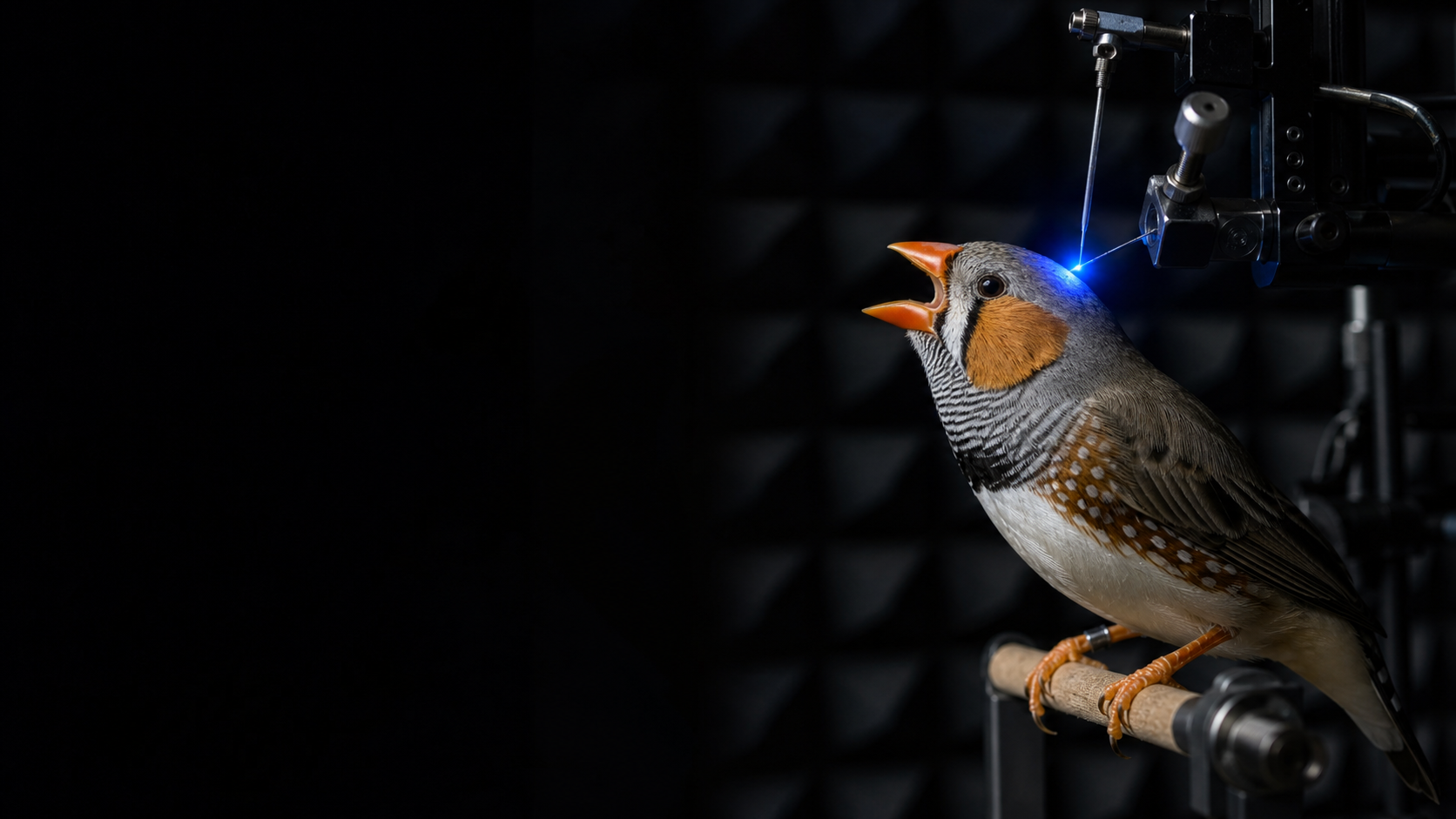
The researchers recorded individual neurons in LMAN, a brain region that adds variation to song. Their system recognized a chosen moment in a song motif, detected spikes from one targeted neuron, and played disruptive white noise when that neuron met a preset condition.
The Feedback Changed One Narrow Slice of Song
The sound arrived 5 to 15 milliseconds after detection. Over the course of a day, the targeted neuron changed its firing at the exact moment tied to the feedback. Reversing the feedback rule reversed the direction of learning.
The learning kernel measured 3.2 plus or minus 0.4 milliseconds. Nearby neurons that lacked a correlation with the feedback did not acquire the same change. Spatial modeling placed the functional feedback spread around 8 micrometers.
The Brain Preserved a Short-Lived Record
The experiments identified an eligibility window that remained measurable for about 126 milliseconds after the relevant neural activity. That temporary record gives a later dopamine signal something precise to reinforce.
Credit Assignment Reached a Single Cell
The work shows how a slow reward system can change a fast motor sequence without smearing the lesson across neighboring cells or nearby moments. In this song circuit, the record of a recent action is precise enough to guide one neuron within a few milliseconds.