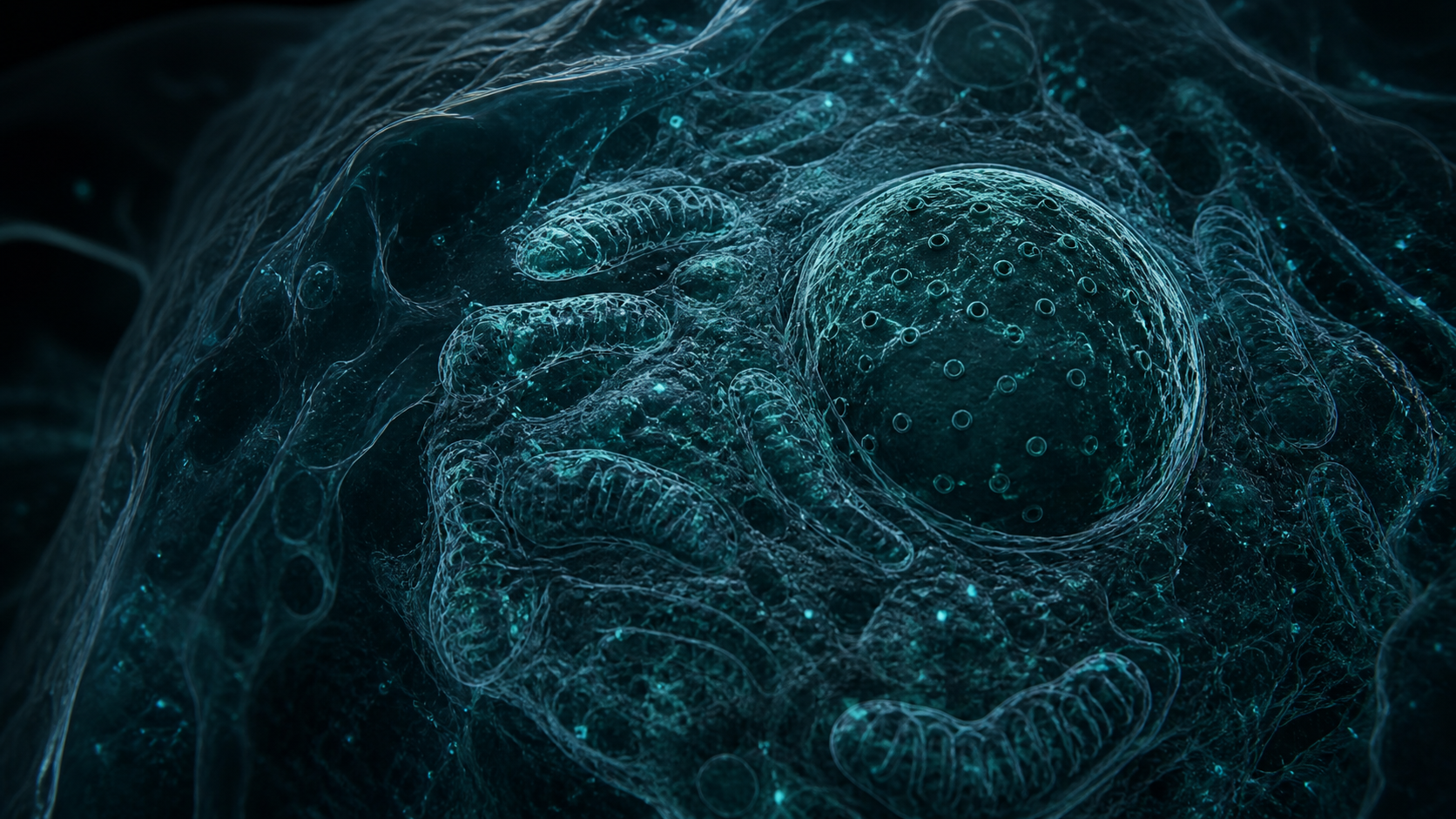
A human cell can swell roughly 250-fold while keeping enough internal structure for an ordinary microscope to resolve molecular architecture.
Mega-expansion microscopy repeatedly embeds, softens, and enlarges fixed biological samples until nanometre-scale structures become separated by distances that a light microscope can see. HeLa cells reached about 228-fold macroscopic expansion after three rounds, while molecular measurements on synaptonemal complexes yielded 253.98-fold. The team reconstructed a neuronal nuclear pore from 20 particles with a reported structural resolution of 34.62 angstroms after scale correction. A fourth round pushed B cells beyond 1,500-fold, where centimetre-scale specimens and diluted fluorescence became practical limits. The method moves the resolution contest from expensive optics toward the chemistry that anchors and labels molecules before the sample expands.
If cells can carry their ultrastructure through 250-fold physical expansion, structural biology just shifted part of the resolution problem from the microscope into the sample.