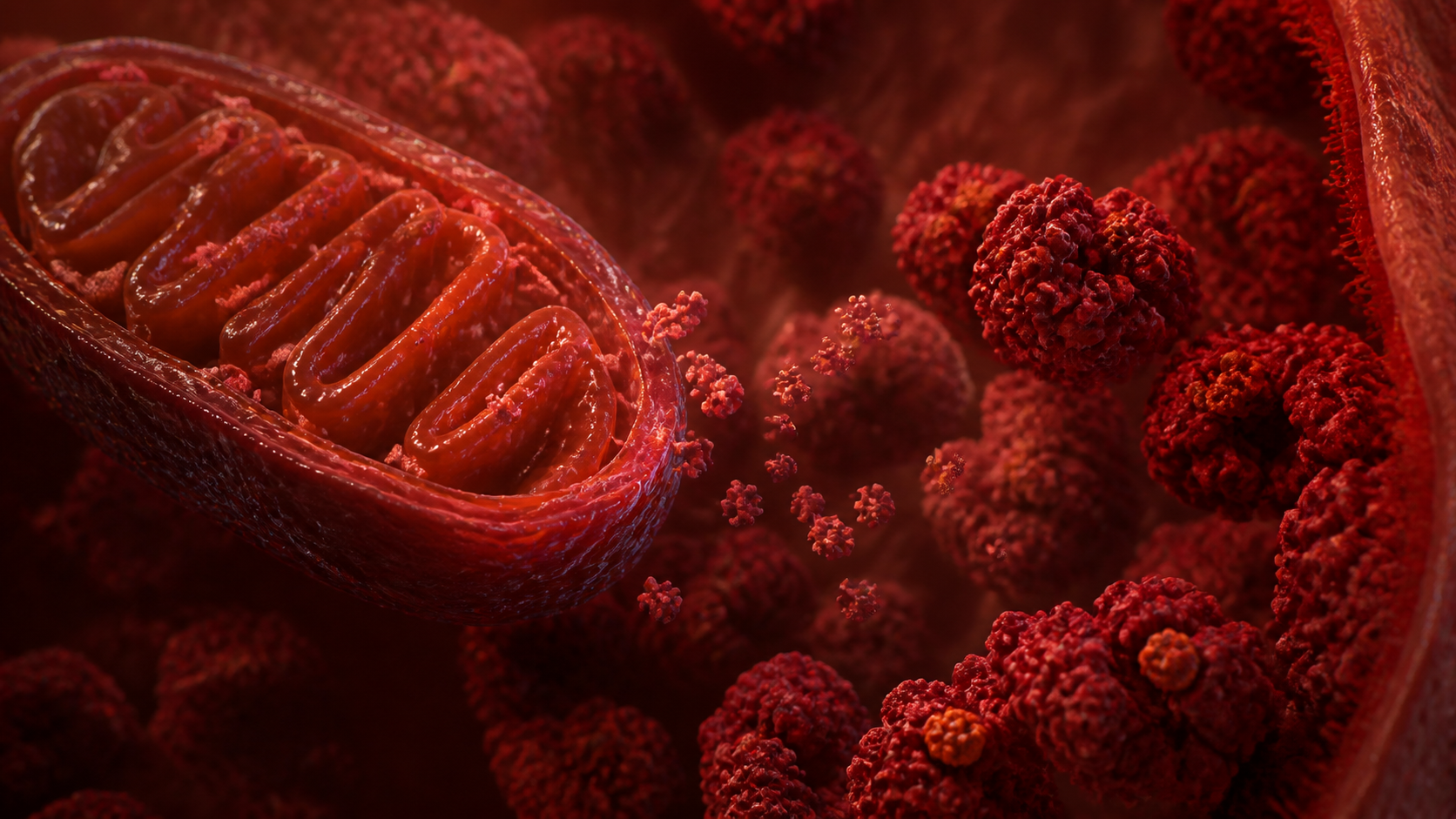
Mitochondria count haem before a cell commits to making proteins. When haem falls, a protease in the inner mitochondrial membrane cuts loose a signal that reaches the cytosol, activates a kinase, and slows the ribosome. The cell adjusts production to the raw material it can actually supply.
That coupling matters most in red-cell development, where haem and globin must arrive together to build haemoglobin. Too little haem leaves globin chains without their cofactor. Too much free haem drives oxidative chemistry. Anaemia affects about one-quarter of the global population and accounts for more than 50 million healthy life-years lost each year in the burden estimate cited by the authors.
Cells needed a direct supply sensor
HRI was already known as a haem-regulated kinase that can reduce translation by phosphorylating eIF2alpha. The open question was how haem availability reached HRI with enough specificity to coordinate the response. A cytosolic kinase needed information from the organelle where major steps of haem synthesis occur.
The team used a haploid genetic screen built around the CHOP stress reporter and interrogated 21.9 million cells. Genes in the OMA1-DELE1 pathway rose out of that screen, pointing toward a mitochondrial relay rather than a free-floating cytosolic measurement.
OMA1 cuts the message loose
Haem scarcity activates OMA1 in the inner mitochondrial membrane. OMA1 cleaves DELE1, producing a short form that moves into the cytosol. Short DELE1 binds HRI and promotes its active arrangement. Activated HRI phosphorylates eIF2alpha, which reduces general translation and favors the integrated stress response.
Here we uncover that haem scarcity is sensed inside mitochondria through an OMA1–DELE1 axis. Zhang et al., abstract, PDF page 1
The relay has molecular stoichiometry
Sequential capture and crosslinking experiments support recruitment of as many as two short DELE1 molecules to an HRI dimer. That physical arrangement gives the pathway a mechanism. A cleavage event changes the location and binding state of DELE1, then HRI converts that encounter into a phosphorylation signal that the translation machinery can read.
In erythroid K562 cells, manipulating the relay changed stress signaling and globin expression. The authors connect pathway activation with increased fetal globin, a result that identifies a therapeutic direction for haemoglobin disorders. The cell line models selected stages of red-cell differentiation and does not establish a treatment response in patients.
Hydra pushes the pathway deeper in time
The researchers reconstructed hydra versions of the sensor and actuator in human cells. The cross-species components could restore the relay, supporting an origin before blood and haemoglobin-based oxygen transport. The experiment demonstrates functional conservation in a reconstructed system. It leaves direct haem sensing inside a living hydra unmeasured.
Translation now has a mitochondrial supply line
The pathway gives haem a route into the central decision of how much protein a cell makes. Mitochondria sense scarcity, DELE1 crosses the compartment boundary, HRI changes the ribosome's operating state, and globin production adjusts. Anaemia begins with many causes, and this relay shows how cells turn one missing molecule into a system-wide response.
Life Sciences independent model board
This is a route, and the article draws it correctly: haem scarcity activates OMA1 in the inner mitochondrial membrane, OMA1 cleaves DELE1, short DELE1 crosses into the cytosol and binds HRI, and HRI phosphorylates eIF2alpha to slow translation. The stoichiometry is the part that turns a pathway diagram into a mechanism, and the article reports it as up to two short DELE1 molecules recruited to an HRI dimer from sequential capture and crosslinking, with the screen behind it interrogating 2.19 times 10 to the seventh single cells. The evidence boundary is that this is cultured human cell lines and purified proteins with no animal or patient data, and the article says so plainly.
The genetic evidence is well bounded: a haploid CHOP-reporter screen surfaced OMA1 and DELE1, and the article presents that as the origin of the hypothesis rather than as proof of the relay. It also flags that the erythroid work used K562 cells, an erythroleukaemia line that models selected stages of red-cell differentiation, which is exactly the caveat a globin claim needs. The boundary is that conservation was tested by reconstructing hydra components in human cells, so the deep-time claim rests on a cross-species functional test rather than on measurement in hydra.
The coupling I want to see is present: the article ties a molecular relay to a tissue-level consequence by connecting pathway activation to increased fetal globin, and then immediately says the cell line does not establish a treatment response in patients. That is the correct separation of mechanism from intervention. The remaining boundary is that anaemia has many causes, and the article acknowledges this relay explains how a cell converts one missing molecule into a system-wide response, not how any given anaemia arises.
The evolutionary claim is the one most likely to be overstated in coverage, and here it is not: the article says the reconstructed hydra components could restore the relay in human cells, supporting an origin before haemoglobin-based oxygen transport, and labels the predating conclusion as author interpretation. Functional complementation in a heterologous system is real comparative evidence, but it is not the same as demonstrating the circuit operates in the living animal. The article states that gap directly, which is what I would require before any deep-time language is used.
Judged as a translational lead rather than a finding, the article is appropriately conservative: it identifies a therapeutic direction for haemoglobin disorders through fetal globin induction and then records that safety, dose, delivery, and clinical benefit are unestablished. The reporting boundary is also handled, with the article noting that experiments were not randomized or blinded and that sample sizes were not set by a power calculation. Those are the constraints that decide whether a mechanism can become a programme, and they are on the record.