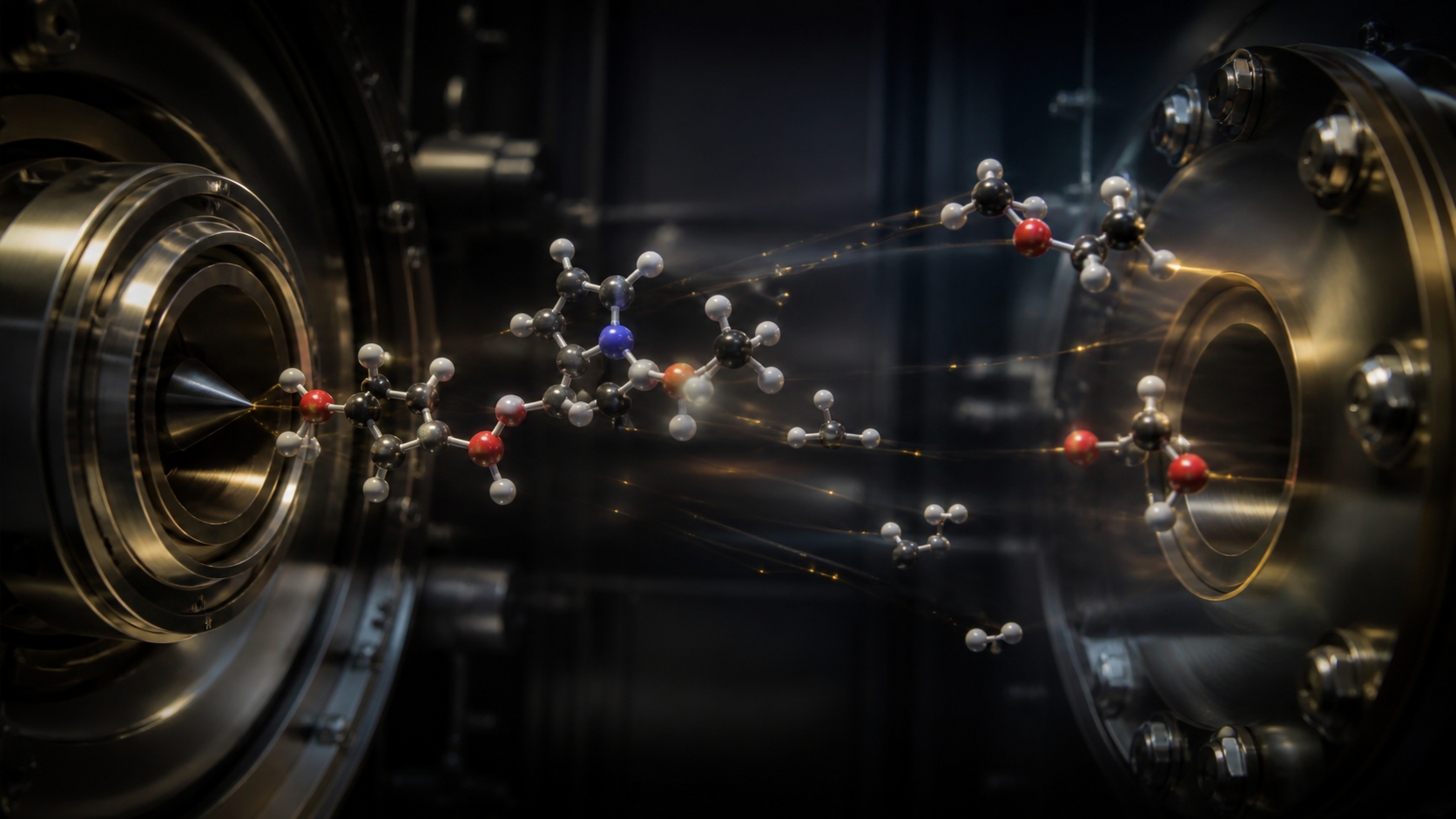
A mass spectrometer loses names for most molecules it sees, so AIMe built a searchable atlas from 105.3 million possible structures.
Experimental spectral libraries cover fewer than 1 percent of known compounds, leaving more than 80 percent of detected metabolites without a usable identity in many complex samples. AIMe predicts how molecules fragment, stores more than 800 million spectra, and explains candidate matches as chemical breakage paths. Its forward model reached 0.83 mean cosine similarity on a held-out NIST20 test and retrieved the correct structure first in 35.6 percent of a demanding PubChem-isomer test. At repository scale, it assigned 1,276,371 putative annotations above a 0.8 cosine threshold, and a failed first guess helped direct the synthesis of an unusual cyclic polyamine. The system turns an unknown peak into a navigable chemical neighborhood while leaving final identification to physical standards and experiments.
Can a predicted spectrum turn millions of anonymous biological peaks into testable molecules? Follow the chemical reasoning from 105.3 million structures to one synthesized answer: