· Tom Hippensteel · Physics · 2 min read
The End of Friction
A Tsinghua team grew single-crystal graphite films that slide with nearly zero friction at the macroscale. Two orders of magnitude past where physics said it should fail.

Friction is one of those things you don’t think about until you realize how much of the world exists just to fight it. Bearings. Lubricants. Engine oil. About 23% of global energy consumption goes toward overcoming friction. A fifth of every motor, every axle, every sliding part… lost to heat.

Pie chart showing 23% of global energy fighting friction.
Physicists have known for decades that there’s a loophole. If you take two crystal surfaces and twist them so the atoms don’t line up, the forces mostly cancel out. Each atom trying to grip gets counteracted by its neighbors pushing the other direction. The surfaces float past each other. Nearly zero resistance.
Unfortunately, it only worked at scales too small to matter. Nanometers. Maybe a few micrometers if you were careful. Make the contact area any bigger and real-world problems crept in. Defects. Contamination. Edges that flex and catch. The magic disappeared.
A team from Tsinghua just broke that barrier.
They grew single-crystal graphite films across centimeters. Perfect atomic structure, no grain boundaries. Then they developed a technique to cleave the layers apart so fast the surface stays pristine. No contamination. No wrinkles. Atomically smooth.
The result: graphite sliders 0.2mm across. Visible to the naked eye. Still frictionless.

Bar chart showing theoretical limit, human hair, and this study.
They pushed on these things with half a newton of force… about the weight of a golf ball… and measured friction so low the instruments sometimes couldn’t tell if it was there at all. The resistance didn’t increase with pressure. In some samples, friction coefficient actually dropped. Push harder, slides easier.
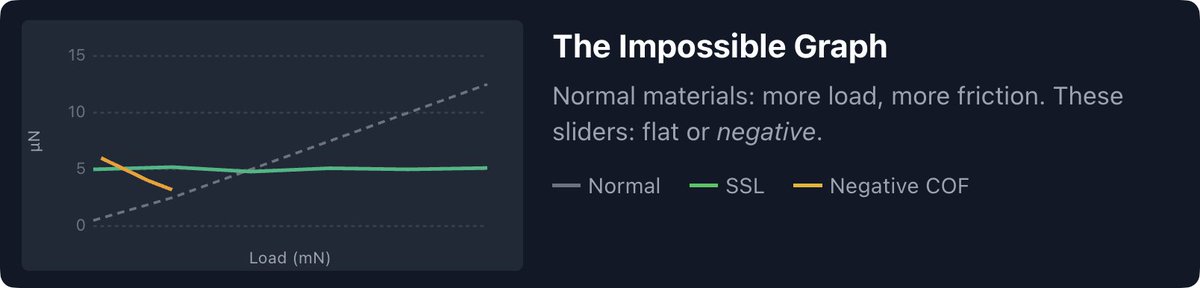
The Friction Graph. Normal materials go up and to the right. These samples go flat or down.
That shouldn’t happen.
They tested graphite sliding on MoS2 too. Different material, same result. The phenomenon isn’t a fluke of one particular setup.
Theoretical models predicted this effect should collapse at around 1-2 micrometers. Something about elastic deformations forcing the atoms back into alignment. The Tsinghua team hit 200 micrometers. Two orders of magnitude past where the physics said it should fail.
Either the models need rewriting or multilayer graphene does something nobody accounted for.
Still early. 0.2mm is a triumph for physics but it’s nothing for an actual bearing. The fabrication is delicate. Nobody’s tested durability at real-world speeds. But that door was supposed to be locked… it isn’t.
Observation of robust macroscale structural superlubricity
arXiv PDF: https://arxiv.org/pdf/2601.00190.pdf