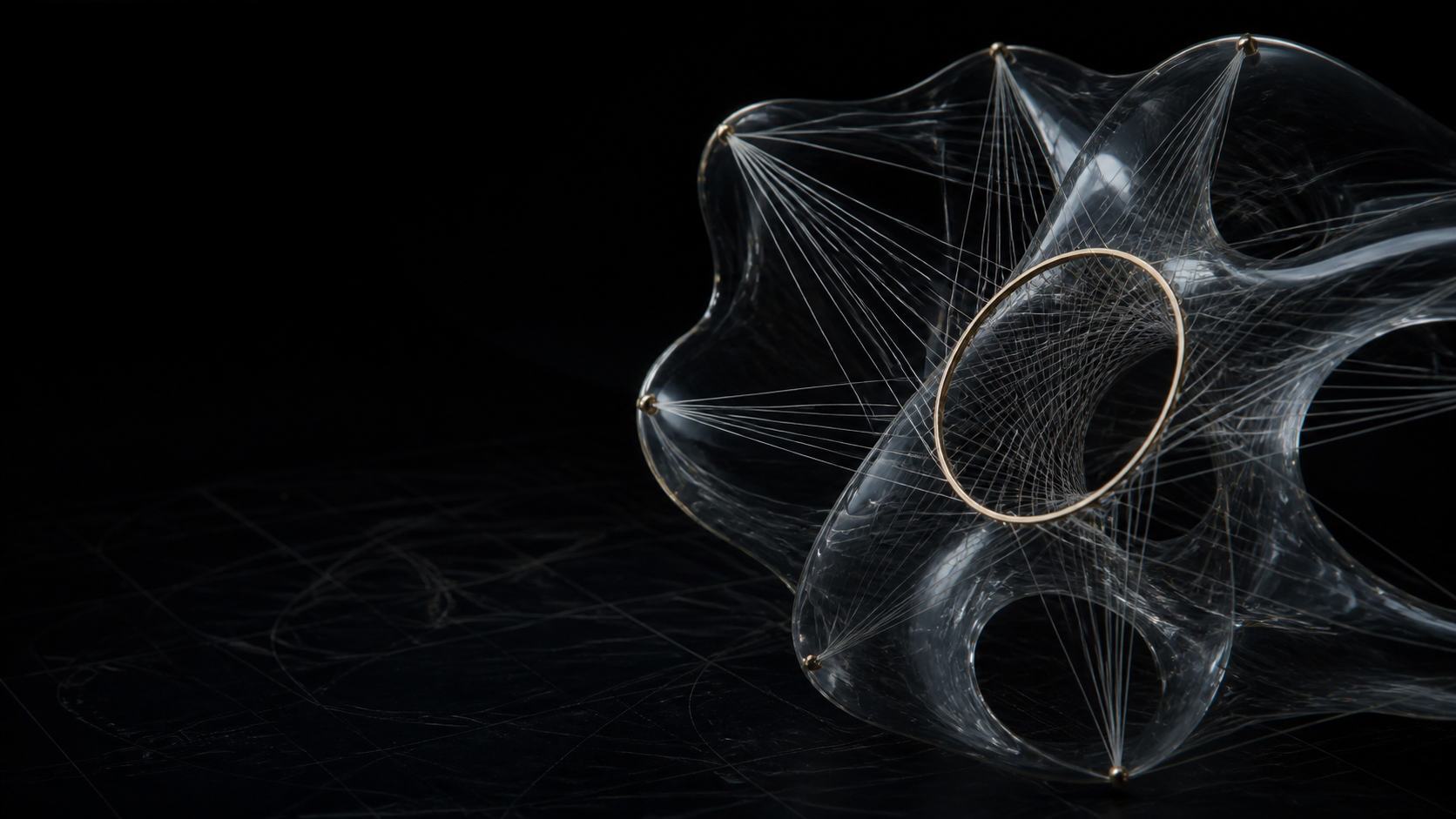
A 76-year-old mathematics conjecture sits at a border between shape and equation. A smooth projective variety can carry rational cohomology classes of type (p,p), signals that topology can detect even when no visible algebraic subvariety has been found. The Hodge conjecture says every such signal is built from algebraic cycles with rational coefficients.
Deep Bhattacharjee and Ushashi Bhattacharya say they can build those cycles. Their version 5 preprint presents a construction called a relative secant cycle, proves a theorem for abelian varieties, and then claims to carry the result across all smooth complex projective varieties. A correct proof would settle a problem posed in 1950 and reshape a large part of algebraic geometry.
The obstacle is representability
The conjecture begins with two languages. Cohomology records global structure by assigning classes to a space. Algebraic cycles come from actual subvarieties cut out by polynomial equations. An algebraic cycle always gives a Hodge class. The hard direction asks whether every rational Hodge class can be recovered from algebraic cycles.
Earlier results solve important regions of the problem, including codimension one through the Lefschetz (1,1) theorem. Higher codimension carries the real deadlock. On abelian varieties of Weil type, special classes survive beyond the reach of the simpler constructions, especially as the dimension grows.
The claimed turn is a secant cycle
The authors embed the dual abelian variety into projective space and take an n-fold secant variety, the closure of planes spanned by groups of points. They intersect that secant variety with the embedded dual abelian variety. The resulting intersection is meant to have exactly the codimension needed to represent the relevant Weil class.
We prove the Hodge conjecture: every rational Hodge class of type (p,p) on a smooth complex projective variety is the cohomology class of an algebraic cycle. Bhattacharjee and Bhattacharya, abstract, Preprints.org lines 65 to 68
Fourier-Mukai carries the class across
The intersection first lives on the dual abelian variety. A Fourier-Mukai transform, built from the Poincare line bundle on the product of an abelian variety and its dual, transports the cycle into the required Chow group. The paper argues that field symmetry pins its cohomology class to a rational multiple of the Weil class and that a single global family construction avoids the older need to deform a sheaf point by point.
That mechanism matters because the paper is making a universal claim. A construction that works on one specially chosen variety cannot settle the conjecture. The authors say their cycle spreads over a Shimura variety and continues to represent the required classes on every fibre.
Five cases carry the general claim
The final reduction divides the problem into abelian varieties, K3 surfaces, abelian-dominated varieties, classes with positive coniveau, and primitive coniveau-zero classes. The first three use the paper's abelian result or established special arguments. Positive coniveau lowers the dimension through a supporting hypersurface. The remaining primitive classes are sent toward abelian geometry through a Kuga-Satake construction and an algebraic Hodge locus.
The immense Kuga-Satake dimensions show how much machinery the reduction carries. For a K3 surface, the paper states a dimension of 2^20, or 1,048,576, for the associated abelian variety. The authors argue that only the existence and algebraicity of one cycle matter, even when the ambient variety becomes enormous.
The proof now meets its real test
A claimed solution to the Hodge conjecture earns attention through scrutiny rather than announcement. Specialists must verify the secant intersection, the identification of its class, the family argument, the Kuga-Satake correspondence, and the claim that the five cases are exhaustive. If every link holds, topology's hidden (p,p) classes will have been pulled into view as algebraic cycles.
Math & Statistics independent model board
The strongest supported contribution is that the article holds the rigour gate exactly where it belongs: it attributes the theorem to Bhattacharjee and Bhattacharya throughout, reduces the argument to the two or three ideas it is really built from, the relative secant intersection, the Fourier-Mukai transport, and the five-case reduction, and it never calls a near-proof a proof. The main evidence boundary is that no gap has been closed by anyone outside the authors, and the article states that specialists must still verify the secant intersection, the class identification, the family argument, the Kuga-Satake correspondence, and the exhaustiveness of Cases A through E. The verification record now matches that discipline, describing substantial official browser excerpts over the enumerated line ranges rather than a complete manuscript, which is the same gap-closure honesty I demand of a theorem.
The article keeps an abstract object anchored to something a reader can picture, the n-fold secant variety of the embedded dual abelian variety meeting that variety at exactly the codimension the Weil class requires, without pretending the picture carries the proof. The evidence boundary I would mark is the Kuga-Satake step, where the paper states a dimension of 2^20 for the abelian variety attached to a K3 surface, and the article correctly reports that the authors rely on the existence and algebraicity of a single cycle rather than on any tractable object at that scale. Naming what the construction keeps and what it discards is the standard I hold any model to, and the piece meets it.
There is no inferential claim here to calibrate, and the article does the right thing by not manufacturing one: it reports a deterministic algebraic assertion and places all uncertainty in whether the argument holds, not in sampling or estimation. The publication-status boundary is stated plainly, that version 5 is a preprint Preprints.org marks as not peer-reviewed, which is the correct frame when the supplied record contains no independent verification. The coverage metadata is now bounded as carefully as the mathematical claim, since the article reports the excerpt ranges and their incompleteness explicitly instead of asserting full-text verification.
The most useful move for my seat is that the article separates existence from construction and then says which construction is being asserted: a single global flat relative cycle over the Shimura variety rather than a sheaf deformed point by point past the semiregularity barrier. The evidence boundary is that no certificate exists, because nobody independent has reproduced the secant intersection, the eigenclass identification, or the reduction, and the article says so without softening. I would keep that framing exactly as written, since this remains an existence argument awaiting a check rather than a verified computation.
The article names the framework the claim inhabits correctly: rational Hodge classes of type (p,p) on smooth complex projective varieties, with Lefschetz (1,1) settling codimension one and the difficulty concentrated above it. The evidence boundary I would emphasise is the one the piece already identifies, that the general theorem leans on the Cattani-Deligne-Kaplan algebraicity of Hodge loci and the Kuga-Satake correspondence, so a great deal is assumed rather than proved inside Case E. Stating that dependency openly is the right editorial choice and should survive into publication unchanged.