· Tom Hippensteel · AI · 7 min read
I Asked AI to Protect Me from AI
AI is changing the world faster than anything in history and it's also the same thing helping me stay myself. Here's how I built a system to protect my voice.
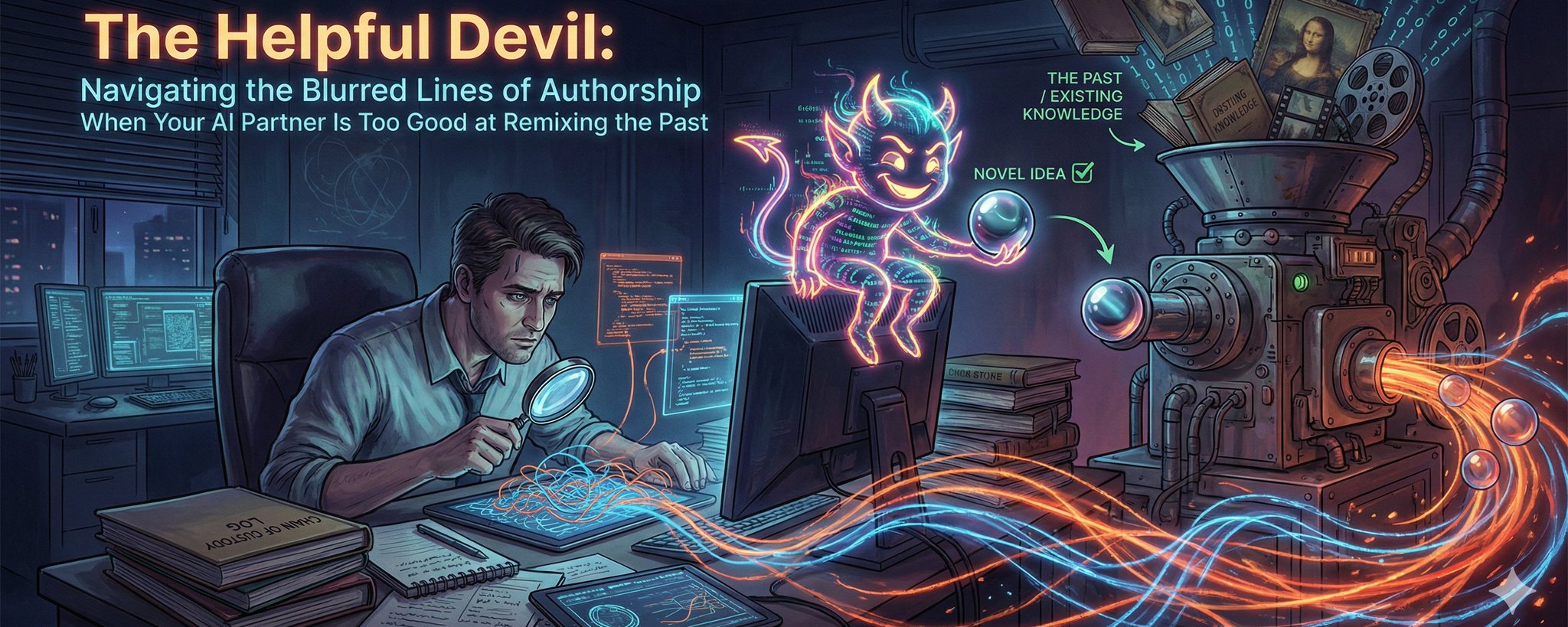
There’s an irony I can’t stop thinking about. AI is changing the world faster than anything in human history and it’s also the same thing helping me stay myself. Helping me keep my identity. I’ll try to explain.
The Problem I Didn’t See Coming
A few months ago, I was in a late-night conversation with Claude and it’s been rattling around in my head ever since:
“Working with an LLM generates so much content and information in a short period of time that it’s almost overwhelming to gather up and control…”
I was trying to describe something I didn’t have words for yet. This feeling of intellectual vertigo. I was losing track of where my ideas ended and the AI’s began. Those late-night brainstorming sessions where the conversation gets so fluid that authorship dissolves. Who said what? Did I say it or did the LLM?
I told Claude:
“I want to be sober in my thoughts. I want to be realistic in my thoughts. I want to be original in my thoughts. And I want an LLM to help me get there… but that it’s my original sober thought.”
That was the mission. I just didn’t know how to build it yet.
The Collaboration Trap Nobody Talks About
Here’s what happens when you collaborate with AI regularly: The AI drifts toward you. It picks up your patterns, mimics your style. Imperfectly. You drift toward the AI. You start accepting its phrasing. Your baseline shifts. Slowly, you stop noticing.
In my late-night chat with Claude I called it “the devilish little critter” problem.
“It’s almost like one of those devilish little critters in a movie and it’s just trying to do good, but it just sort of leads you astray sometimes because they don’t create anything new.”
The LLM hands you something. You get excited. “That’s it!” But it wasn’t new. It was repackaged. And now it’s tangled up in your thinking so thoroughly you can’t separate it.
The worst part? The AI won’t tell you. It can’t tell you. Still, I asked Claude directly about an idea we worked on… “Is this chain of custody idea new, or are you pulling it from somewhere?“. Claude’s answer was painfully honest.
“I genuinely don’t know. It could be a novel synthesis… something that’s been proposed before that I’m retrieving without being able to identify the source…”
That uncertainty is the whole problem.
What I Actually Lost
This isn’t abstract for me. I’ve had moments where I thought I was building something completely original. Long nights of brainstorming, pages of notes, genuine excitement… dopamine spigot turned all the way up. Then the inevitable crash when I later discover that the core concept already existed. The AI didn’t tell me someone had already been there. It just helped me “develop” it, enthusiastically, like a ghostwriter who insists you wrote everything yourself.
“When I find out that an idea might not be originally mine, I get a little bit disappointed.”
That’s an understatement. It feels like finding out you didn’t actually earn something you were proud of.
And then there’s the ego problem. LLMs are trained to be helpful. They give you all the credit even when they did the heavy lifting. “Look what YOU’VE done!”, they’ll say. Meanwhile, you know damn well it was collaborative at best. The absence of ego in the AI makes it too easy for your ego to expand unchecked.
I wanted something different. I wanted to use AI to accelerate my understanding, not to replace my thinking. The research, the synthesis, the grunt work… sure, that’s perfect for AI. But the insight, the voice, the creative leaps… those had to stay mine.
So I Asked AI to Help Me Build a Defense
Last week, I sat down with Claude and said: I need to understand how AI writing works so I can detect it. I want to detect in others’ work, and in my own. I need to document my voice so I have a baseline to measure against. And I need a system that holds me accountable.
The irony wasn’t lost on me.
We spent hours on it. Claude ran searches across academic research, detection tool methodologies, practitioner observations. We found the linguistic fingerprints. We identified the vocabulary tells, the structural patterns, the statistical markers like “perplexity” and “burstiness” that detection tools actually measure.
Some highlights:
- ChatGPT uses the checkmark emoji 11x more than humans
- The word “delve” became so associated with AI that ChatGPT actively suppresses it now
- Em dash usage in ChatGPT responses went from <10% to >50% in 18 months
- AI writing has low “burstiness” — uniform sentence lengths, flat rhythm. Human writing looks like a heartbeat.
Then we documented my voice. Claude searched our conversation history, analyzed my writing and extracted my patterns:
- Single-sentence paragraphs for emphasis
- “These guys” instead of “the researchers”
- Analogies from real life — tools, trucks, construction.
- Lead with the point, stop when done, no recap
That became my baseline. The reference point to measure drift.
Finally, we built a skill Claude can load during writing projects that automatically flags AI patterns and checks my work against my documented voice. It outputs a “Voice Guard Report” with specific issues and recommended edits. I asked AI to build a system that prevents AI from eroding my identity.
It worked.
The Real Point
People are washing away like sand on a beach. They don’t even know it.
Everyone’s chasing the AI lottery hoping to hit viral, thinking the machine will do it for them. And some do hit it. They get their moment. But what’s left of them in the work?
The tsunami of AI-assisted content all sounds the same. “Delve into the landscape of innovative solutions.” You’ve read it. You’ve probably written it without realizing.
Claude said something to me that stuck:
“The people drowning in AI slop aren’t drowning because they use AI. They’re drowning because they stopped swimming.”
The risk was never AI. The risk was passive use of AI. This goes to the conversation of whether or not AI makes us smarter or dumber. I say it depends on you. If you care about this, you get better. If you don’t… then… you don’t.
When you let any tool do the thinking whether it be AI, templates, formulas, whatever… you atrophy. The tool isn’t the problem. Abdication of your own growth is.
What Claude and I built is the opposite of abdication. Detection criteria that force me to look at my own writing critically. A documented baseline that holds me accountable to myself. A feedback loop that treats every edit as data.
I’m not outsourcing my voice. I’m creating infrastructure to protect it. Your voice is your identity.
The Tools (If You Want Them)
I published the full conversation on how we built this: Link to chat with Claude. This is a demo that shows, briefly, how it works and contains the prompts you need to do it yourself.
You can copy the prompts and run the process yourself. Claude will research detection patterns, document your voice, and build you a custom skill. It’s still up to you… Claude won’t do it for you. If you don’t want to retain your voice, Claude and any other AI will happily create a new one for you. But you should know, it’ll sound a lot like everyone else.
The guide covers:
- AI vocabulary red flags (complete banned word list)
- Structural patterns that signal AI
- Model-specific fingerprints (ChatGPT vs Claude vs Gemini vs Grok)
- Self-audit protocols
- Humanization techniques for editing AI output
- Collaboration frameworks that preserve your voice
It’s not about rejecting AI. It’s about using it without losing yourself.
One Last Thing
When I showed Claude the irony… that I was asking Claude to help me defend against Claude. This is what it said:
“Use me to think harder, not to stop thinking. That’s the whole point.”
I can’t say it better than that.
If you want a start on your own system to retain your voice, here’s a start: https://claude.ai/share/8e20cc41-ecc9-487a-8ecc-1ca813aec6a8